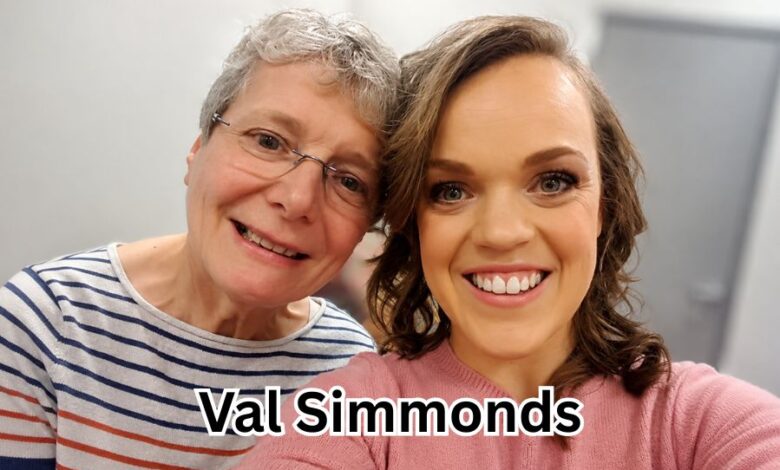
Val Simmonds: The Remarkable Mother Behind Ellie Simmonds’ Success
The devoted adoptive mother whose sacrifice, resilience and lifelong support helped shape Ellie Simmonds into a Paralympic champion.

Introduction
Val Simmonds may not have pursued public recognition, yet her influence is evident throughout the extraordinary life of her daughter, British Paralympic swimming champion Ellie Simmonds. As Ellie became one of Britain’s most admired athletes, winning five Paralympic gold medals and breaking major world records, the strength of the family supporting her remained an important part of her story.
Val and her husband, Steve Simmonds, adopted Ellie when she was only three months old. They welcomed her into a large family where disability was neither treated as a barrier nor allowed to determine what a child could achieve. Val’s parenting combined affection, stability, practical support and an expectation that every child should be encouraged to explore their abilities.
Her most widely recognised sacrifice came when Ellie was 11. To give her access to elite swimming facilities and professional coaching, Val moved to Swansea with Ellie, while Steve remained in the West Midlands with their other children. The arrangement separated the family during the week for several years, but it helped create the training environment in which Ellie’s exceptional talent could develop.
The story of Val Simmonds is therefore not simply about being the mother of a celebrated athlete. It is about the quiet choices and steady support that helped shape a child’s future.
Quick Bio
| Field | Details |
|---|---|
| Full Name | Valerie Simmonds |
| Known As | Val Simmonds |
| Date of Birth | May 1953 |
| Age | 73 years old, as of 2026 |
| Nationality | British |
| Famous For | Being the adoptive mother of Paralympic champion Ellie Simmonds |
| Husband | Steve Simmonds |
| Children | Five adopted children, including Ellie Simmonds |
| Foster Care Work | Reportedly fostered more than 70 children with her husband |
| Occupation | Company director and former foster carer |
| Business Role | Director of Ellie Simmonds Limited since 2010 |
| Notable Contribution | Moved to Swansea with Ellie to support her professional swimming training |
Who Is Val Simmonds?
Val Simmonds is the adoptive mother of retired British Paralympic swimmer and television personality Ellie Simmonds. Public company records identify her as Valerie Simmonds and state that she was born in May 1953. She is British and has maintained a largely private life despite her daughter’s international fame.
Unlike Ellie, Val has not built a public career in sport, television or entertainment. Much of what is known about her comes from Ellie’s interviews, documentaries and reflections on her childhood. These accounts present Val as an active, practical and determined mother who devoted considerable time to supporting her children.
Within the Simmonds household, Val was remembered as the parent who organised activities and transported the children wherever they needed to go. That role became especially important once Ellie’s potential as a competitive swimmer became clear. Training required regular travel, specialist coaching and eventually a major family relocation.
Val’s significance is therefore closely connected to the environment she and Steve created. They did not attempt to manufacture a sporting champion. Instead, they provided Ellie with opportunities while allowing her own motivation and competitive personality to lead the way.
Val Simmonds and the Adoption of Ellie Simmonds
Ellie Simmonds was born in November 1994 with achondroplasia, the most common form of dwarfism. She entered foster care as a baby and was adopted by Val and Steve Simmonds at three months old. Ellie became the youngest of five adopted children in the family.
The adoption gave Ellie a secure home in the West Midlands, where she grew up alongside three sisters and one brother. At least one of her sisters also has achondroplasia, meaning Ellie was not raised apart from other people who shared aspects of her experience.
This family environment appears to have played a major role in her confidence. Ellie has spoken about being aware that she was shorter than most people, but she did not grow up believing that her height automatically prevented her from participating in everyday life. Her parents did not make unnecessary exceptions for her or encourage her to view herself as incapable.
That approach was significant. Val and Steve recognised that disability could create genuine physical and social challenges, but they did not reduce their daughter’s identity to a medical diagnosis. Ellie was treated as a child with interests, responsibilities, ambitions and a naturally competitive personality.
Val and Steve were open with Ellie about her adoption. Rather than hiding her background, they allowed her to grow up understanding that she had been adopted. As an adult, Ellie explored her biological family and the circumstances surrounding her adoption through documentary work. Throughout that emotional process, she continued to speak warmly about the loving and supportive childhood created by her adoptive parents. This openness also reflects the family’s broader approach to care.
A Family Built Through Adoption and Fostering
Val and Steve’s Commitment to Vulnerable Children
The Simmonds family story extends beyond Ellie’s adoption. Val and Steve reportedly fostered more than 70 children over the years and legally adopted five. Some of the children they welcomed had disabilities or additional support needs.
Fostering such a large number of children reflects long-term commitment rather than a single act of generosity. Foster care can involve children arriving with different emotional, developmental and practical needs. Some placements may last briefly, while others continue longer. Each child requires security, patience and the reassurance that they will be treated with dignity.
Although Val has not publicly documented every part of this work, the scale of the family’s fostering experience provides important context for understanding Ellie’s upbringing. The Simmonds household was shaped by inclusion, adaptation and the belief that children should not be dismissed because their circumstances were complicated. That same outlook runs through the family’s everyday life.
The family was large, with a considerable age difference among the siblings. Ellie has described herself as the baby of the family, with more than 20 years separating her from some of her older siblings. Despite those age differences, she has recalled a close family life involving cycling, long walks, park picnics and holidays within the United Kingdom.
Creating Normality Without Ignoring Individual Needs
One of the most meaningful features of Val’s parenting was the balance between normality and individual support. Ellie was not constantly reminded that she was different, yet her parents remained prepared to make substantial changes when a genuine opportunity emerged.
This distinction matters. Supporting a disabled child does not mean denying the realities of disability, nor does it mean treating every part of the child’s life as exceptional. Val appears to have understood that Ellie needed both ordinary family experiences and access to specialist opportunities. That balance carried into the next stage of Ellie’s training.
The family’s attitude encouraged independence. Ellie was expected to participate, work hard and make the most of her abilities. That foundation later helped her manage the pressure of elite competition, international travel, media attention and public expectations at an unusually young age.
The Swansea Move That Changed Ellie’s Career
A Difficult Decision at the Age of 11
When Ellie was 11, her swimming development reached the point where local training alone was no longer enough. Swansea offered access to high-level facilities, including a professional 50-metre pool and training with members of the Great Britain swimming programme.
Val and Steve then faced a decision that would affect the whole family. Val moved to Swansea with Ellie, while Steve remained at home in the West Midlands with their other children. The arrangement allowed Ellie to train at a far more advanced level, but it required the family to live separately for much of the week.
Val created a small home in Swansea so that Ellie could retain a sense of normality while completing schoolwork and following an intense training schedule. Every weekend, they made the long journey back to the family home before returning to Swansea on Sunday.
Ellie later described this arrangement as a major sacrifice made by both parents. Steve took responsibility for the home and the other children, while Val managed Ellie’s daily life, education and training in Swansea. The commitment lasted for almost six years. It was a practical response to Ellie’s growing potential.
Support Without Becoming Overbearing
Elite sport can create complicated relationships between young athletes and their parents. Ambition may become pressure, while encouragement can gradually turn into control. Ellie’s recollections suggest that Val and Steve avoided becoming overly demanding.
They supported their daughter’s talent without attempting to claim ownership of it. Ellie’s competitiveness came from within. She loved moving quickly through the water and enjoyed testing herself against other swimmers. Her parents made the opportunities possible, but the desire to succeed remained her own.
This is one of the strongest lessons in Val Simmonds’ story. Effective parental support does not require relentlessly pushing a child. It requires recognising genuine enthusiasm, providing appropriate resources and helping the child cope with the responsibilities that follow.
The Swansea move was not a guarantee of medals. At the time, it was a carefully considered investment in Ellie’s potential. Its importance became clear when she qualified for the 2008 Beijing Paralympic Games at only 13 years old.
Val’s Influence on a Paralympic Champion
Ellie became the youngest member of the British team at the Beijing Paralympics. She won two gold medals in the S6 100-metre and 400-metre freestyle events, transforming herself from a talented young swimmer into a nationally recognised sporting figure.
She later won two more gold medals at the London 2012 Paralympic Games and another at the Rio 2016 Paralympic Games. By the end of her competitive career, she had collected five Paralympic gold medals, along with silver and bronze medals, world titles, European titles and multiple world records.
These achievements belonged to Ellie, her coaches and the professional teams that supported her career. However, her success cannot be separated from the family foundation that enabled her to reach elite training in the first place.
Val’s contribution was not limited to driving Ellie to the swimming pool. She helped her daughter maintain a routine during a period of major change, managed the practical demands of living away from the main family home and provided emotional stability as Ellie entered international competition while still a child.
She also helped reinforce an attitude that would remain central to Ellie’s public identity: a disability may influence a person’s experience, but it does not define the full extent of that person’s future.
Val Simmonds’ Role in Ellie Simmonds Ltd
Val also has a formal business connection to her daughter’s professional activities. She has served as a director of Ellie Simmonds Limited since February 2010. Public records list the company as active and identify Val as one of its directors.
The company was established after Ellie had become a recognised Paralympic champion but while she was still a teenager. A corporate structure can help manage the commercial and administrative responsibilities connected with speaking engagements, media appearances, partnerships and other professional work.
Val’s involvement reflects the level of trust within the family. It also demonstrates that her support continued after Ellie moved beyond childhood competition and developed a wider career in broadcasting, documentary production, charity work and public speaking.
Holding a directorship is different from being a public-facing manager or celebrity representative. There is no reason to assume that Val controls every element of Ellie’s career. Nevertheless, her long-standing position indicates an ongoing role in the responsible administration of her daughter’s professional interests.
Life Away from Public Attention
Although Ellie has become a familiar figure on British television, Val has remained comparatively private. She does not appear to seek celebrity status or use her daughter’s achievements to establish a separate public identity.
This privacy should be respected. Available information helps explain Val’s importance to Ellie’s development, but it does not provide a complete account of her early life, education or personal interests. A responsible profile should not attempt to fill those gaps with speculation.
What can be understood is the pattern visible in her decisions. She adopted children who needed permanent homes, participated in fostering over many years, supported children with different needs and reorganised her life when Ellie’s swimming career required specialist training.
The public may remember Ellie’s emotional medal celebrations and record-breaking performances, but Val’s contribution was largely made away from cameras. It existed in early mornings, training journeys, school arrangements, weekend travel and the daily work required to make an unusual family arrangement sustainable.
Why Val Simmonds’ Story Matters
Val Simmonds’ story is valuable because it broadens the usual understanding of sporting success. Medals are won during competition, but the path to the podium often begins years earlier through decisions made within a family.
Her experience also contributes to wider conversations about adoption and disability. Ellie’s life challenges the damaging assumption that a disabled child cannot enjoy independence, success or a fulfilling future. The environment created by Val and Steve allowed their daughter to develop confidence before the wider world knew her name.
At the same time, their story does not suggest that love alone removes every difficulty. Raising children, supporting people with disabilities, and fostering and managing elite sport all involve demanding practical realities. What stands out is the family’s willingness to respond to those realities without allowing fear to set the limits of Ellie’s ambition.
Val’s example shows that meaningful support can be both emotional and practical. Encouragement mattered, but so did relocation, transportation, organisation, stability and the willingness to divide parental responsibilities for the benefit of the whole family.
Conclusion
Val Simmonds is best known publicly as the adoptive mother of Ellie Simmonds, but her story goes far beyond that. Together with her husband, Steve, she helped create a home centred on security, inclusion, encouragement and opportunity. The couple adopted five children and reportedly fostered more than 70, demonstrating a sustained commitment to children who needed care and stability.
Val’s decision to move to Swansea with 11-year-old Ellie became one of the defining moments in the swimmer’s development. It gave her access to elite facilities while requiring years of travel, separation and careful family organisation. That sacrifice helped provide the conditions in which Ellie could become a five-time Paralympic gold medallist.
Her continuing role as a director of Ellie Simmonds Limited further reflects a relationship built on trust and long-term support. Val may have remained outside the spotlight, but her influence is present throughout her daughter’s journey. Her legacy is not measured in medals of her own, but in the lives she helped nurture and the possibilities she refused to limit.
(FAQs)
Who is Val Simmonds?
Val Simmonds is the adoptive mother of former British Paralympic swimmer Ellie Simmonds. Alongside her husband, Steve Simmonds, she created a supportive family environment that helped Ellie develop confidence, independence and the determination needed to pursue elite swimming.
When did Val Simmonds adopt Ellie Simmonds?
Val and Steve Simmonds adopted Ellie when she was approximately three months old. Ellie had initially been placed in foster care after her birth. She later grew up as the youngest of the couple’s five adopted children.
Why did Val Simmonds move to Swansea?
Val moved to Swansea with Ellie when Ellie was 11 years old. The move allowed Ellie to access a professional 50-metre swimming pool, specialist coaching and the advanced training environment required to develop her Paralympic potential.
How many children did Val and Steve Simmonds foster?
Val and Steve Simmonds reportedly fostered more than 70 children during their years as foster carers. They also legally adopted five children, including Ellie. Some of the children they supported had disabilities or additional care needs.
What is Val Simmonds’ business role?
Val Simmonds has served as a director of Ellie Simmonds Limited since 2010. Her position reflects her ongoing involvement in the administrative and professional aspects of her daughter’s career, including activities related to media work and public appearances.