Comisaco: The Irrigation Partnership Supporting Uruguay’s Rice-Producing Heartland
How Comisaco Supports Irrigation, Water Management, and Rice Production in Uruguay

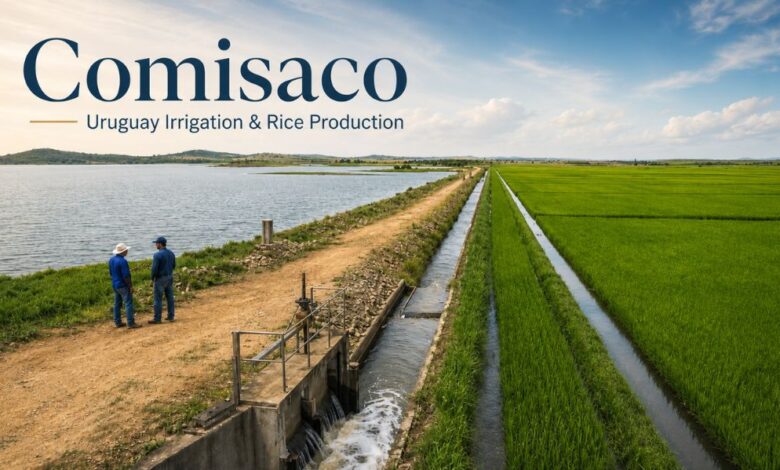
In Uruguay’s rice-growing regions, water is not simply a natural resource; it is part of the infrastructure that enables dependable agricultural production. Comisaco is closely connected to that reality through its role in administering the India Muerta dam and irrigation system in the department of Rocha. The company is linked to two important names in Uruguay’s rice industry, SAMAN and COOPAR, and its work centers on managing a major reservoir and a large network that supplies water to productive farmland. Although Comisaco is not widely known outside agriculture, its importance becomes clearer given rice farming’s needs.
Rice cultivation depends heavily on reliable water access, careful distribution, infrastructure maintenance, and coordination among agricultural users. Comisaco therefore represents more than a company name: it is part of a long-running system connecting water management, private-sector cooperation, rural infrastructure, and one of Uruguay’s established agricultural industries.
What Is Comisaco?
Comisaco S.A. administers the India Muerta dam, a large irrigation reservoir serving an important rice-producing area in eastern Uruguay. Information from its associated companies identifies SAMAN and COOPAR as the venture’s partners, with SAMAN holding a 50 percent interest. Historical references also connect the name Comisaco with the joint participation of SAMAN and COOPAR in managing the irrigation concession. Rather than producing rice as its defining activity, Comisaco is best understood as an irrigation-management and water-infrastructure entity. Its importance lies in organizing access to a resource producers need at the right time and in sufficient volume. That places the company at the intersection of agriculture, engineering, business, and regional resource management.
The Partnership Behind Comisaco
The partnership model illustrates how shared infrastructure can be managed when several agricultural interests depend on the same resource. SAMAN and COOPAR are both connected with Uruguay’s rice industry, and their participation in Comisaco creates a structure through which a major irrigation asset can be administered with direct awareness of production needs. The India Muerta irrigation service began operating in the early 1980s and has since become closely associated with rice cultivation in the surrounding region. A dedicated operator can focus on stored water, canal flows, seasonal demand, and maintenance. Comisaco’s relevance is therefore tied to coordination, not simply ownership.
The India Muerta Dam and Its Strategic Importance
The India Muerta Dam is located in Rocha, between Velázquez and Lascano, in a landscape where rice production is economically important. The reservoir reportedly contains about 127.5 million cubic meters of usable water, while the irrigation network spans more than 200 kilometers of canals. Industry information also indicates an annual irrigation capacity of roughly 10,000 hectares for rice cultivation, although the actual irrigated area can vary with agricultural and hydrological conditions. The wider system is described as reaching around 40,000 hectares. These figures explain why Comisaco matters. Managing a reservoir of this scale involves a large physical asset, a broad distribution network, multiple users, and seasonal pressure to deliver water when crops need it most.
A Large Engineering System, Not Just a Reservoir
India Muerta is not only a body of stored water; it is an engineering network. Published information describes an embankment constructed from about 1.763 million cubic meters of clay and a dike extending for roughly 3,200 meters. Beyond the dam itself, canals are essential because water has limited agricultural value unless it can be moved efficiently to productive areas. Control points, pumping arrangements, monitoring equipment, and farm-level distribution all contribute to the wider system. Technology providers have also referenced monitoring projects associated with Comisaco, including measuring lake levels at India Muerta and monitoring matters, because operators need accurate information before making distribution decisions.
Why Comisaco Matters to Rice Production
Rice cultivation normally requires carefully managed water during important stages of the growing cycle. In a region where commercial rice farming is a major agricultural activity, reliable irrigation can influence planting decisions, crop security, operating costs, and the amount of land that can be successfully cultivated. Comisaco supports this production environment by administering shared irrigation infrastructure rather than leaving farms to rely only on isolated water sources. A reservoir of this scale can provide a level of water security that many individual producers would struggle to achieve on their own. Stored water also helps reduce exposure to short-term rainfall variability during the irrigation season. It does not eliminate agricultural risk, but it gives producers a key resource to plan production around.
Water Reliability and Agricultural Planning
Reliable irrigation affects decisions made long before harvest. Producers must consider how much land to plant, which inputs to buy, how to schedule machinery and labor, and whether expected water supplies are adequate. When an irrigation system serves thousands of hectares, reservoir levels and distribution decisions become part of broader regional planning. This makes water efficiency especially important. Public-sector visits to India Muerta have included discussion of efficient water use in rice farming, showing that the reservoir is also relevant to broader questions about agricultural resource management. Better distribution can reduce avoidable losses, stretch available reserves, and strengthen resilience under greater pressure.
Comisaco and the Broader Rural Economy
The influence of irrigation extends beyond farms receiving water directly. Rice production supports a larger chain that may include seed suppliers, machinery operators, transport companies, storage facilities, mills, consultants, maintenance contractors, and export-related businesses. As a result, infrastructure that improves production stability can influence the regional economy more broadly. Comisaco’s role is operational, but its effects extend further. A functioning irrigation network helps support continuity, while inadequate water can create difficulties across several stages of the agricultural chain. Over time, reservoirs and canals can also shape land use, logistics, investment, and commercial relationships, becoming embedded in a region’s economic geography.
Cooperation Between Agriculture and Water Management
One of the most notable aspects of Comisaco is the way its purpose combines agricultural interests with infrastructure administration. Water management requires technical discipline, while farming requires flexibility because each season brings different rainfall, temperatures, planting patterns, and market conditions. Bringing those realities together demands coordination between operators, producers, engineers, businesses, and public authorities. The India Muerta system has also appeared in discussions of water efficiency and potential small-scale energy applications, showing that a large reservoir can attract interest beyond irrigation alone. Even so, Comisaco’s significance lies in its role in agricultural water supply and rice production.
Challenges and Responsibilities in Managing a Major Irrigation System
Operating a large irrigation network creates significant responsibilities. Water is finite, infrastructure ages, canals require maintenance, and agricultural demand can change from season to season. Managers must consider reservoir storage, distribution efficiency, technical monitoring, system upkeep, and concession requirements. Environmental factors also matter because irrigation interacts with soils, waterways, wetlands, biodiversity, and nearby communities. Long-term sustainability depends on balancing productive use with responsible water management. Comisaco operates within a wider regulatory and environmental framework, but its administrative role makes effective system performance a central responsibility.
The Importance of Long-Term Infrastructure Thinking
The history of India Muerta shows why agricultural infrastructure must be judged over decades, not individual seasons. Irrigation service began in the early 1980s, meaning generations of production decisions have been made in a landscape shaped by this system. Long-lived infrastructure requires inspection, maintenance, technical knowledge, and adaptation. Improved monitoring can provide better information on levels and flows, while more efficient farming practices can increase the value of available water. Climate variability may make these capabilities increasingly important because both prolonged dry periods and unusually wet conditions can complicate agricultural planning. For Comisaco, the challenge is not simply preserving an existing asset but keeping a mature irrigation system useful and responsive.
Conclusion
Comisaco is an important but specialized part of Uruguay’s agricultural infrastructure. Through its administration of the India Muerta dam and irrigation system, it is directly connected with the water needs of one of the country’s important rice-producing areas. Its partnership structure, association with SAMAN and COOPAR, large reservoir, extensive canal network, and decades of irrigation activity explain why the organization matters. Its real significance lies in what the system enables: dependable water storage, coordinated distribution, agricultural planning, and support for thousands of hectares of rice production. Comisaco also illustrates a broader truth about modern farming: successful agriculture depends not only on land and skilled producers but also on infrastructure, engineering, cooperation, monitoring, and responsible water management.
(FAQs)
1. What is Comisaco in Uruguay?
Comisaco administers the India Muerta irrigation system in Rocha, Uruguay, supporting agricultural water management and rice production.
2. What does Comisaco mainly do?
Comisaco mainly manages key irrigation infrastructure, including water storage and distribution systems connected to the India Muerta reservoir and the surrounding agricultural areas.
3. Where is Comisaco’s irrigation system located?
Comisaco’s irrigation system is located in Uruguay’s Rocha department, particularly around the India Muerta reservoir.
4. Why is Comisaco important for rice farming?
Comisaco helps provide a more reliable water supply for rice-growing areas, supporting crop planning, irrigation efficiency, and agricultural productivity.
5. Which companies are connected with Comisaco?
Comisaco is associated with SAMAN and COOPAR, two organizations with established connections to Uruguay’s rice industry.